
How web agencies find clients who are already asking
FirstAsk team · October 6, 2026
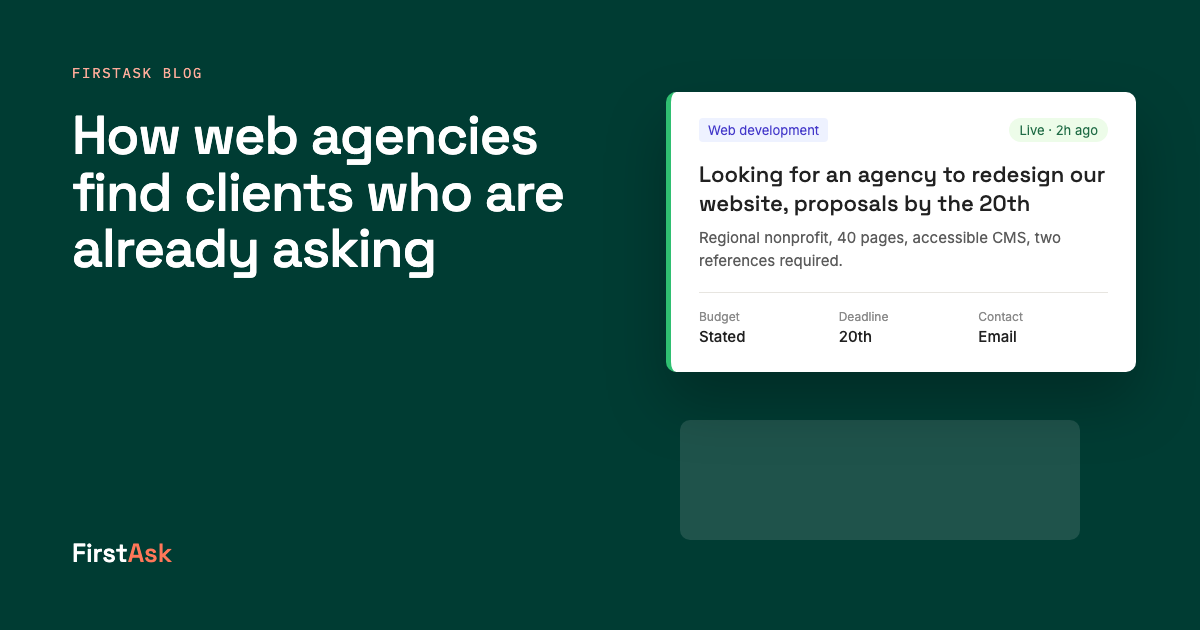
Most agencies find new work the same three ways: referrals, outbound, and marketplaces. Referrals are the best leads you will ever get, but you cannot schedule them. Outbound means writing to people who did not ask to hear from you. Marketplaces put you in a queue with dozens of other bidders.
There is a fourth source that sits in plain sight: people who say, in public, that they need exactly what you sell. A café owner asking a local Facebook group who can rebuild their site. A founder on Reddit looking for a developer to finish an MVP. A city council publishing a tender for a new website. These people have already decided to spend money. The only open question is who they will hire.
This article covers where those requests appear, how to judge them quickly, and how to reply in a way that gets a response.
Where buyers post requests
Requests for digital work show up in more places than most agencies watch.
Communities and social platforms. Subreddits such as r/forhire, r/smallbusiness and r/entrepreneur, Facebook groups for local business owners, LinkedIn posts that start with "Looking for…", and threads on X. These are usually small and medium jobs: a new site, a Shopify migration, an SEO audit, a paid-ads setup.
Developer and founder communities. Hacker News "who wants to be hired" and "freelancer" threads, Indie Hackers, and the job or "help me build" boards of tool communities such as n8n, Webflow and Bubble. These skew toward apps, automation and integration work.
Public procurement portals. Governments, universities, health bodies and nonprofits publish requests for proposals for websites, digital marketing, software and data work. In the US there is SAM.gov plus state and city portals; in the UK, Contracts Finder and Find a Tender; in the EU, TED; and national portals across Canada, Australia, New Zealand and beyond. Budgets are often stated, and the process is formal, but the competition is frequently thinner than you would expect. Our RFP and tender alerts page lists the portals FirstAsk watches.
Search results. Many organisations post an RFP on their own website and never list it anywhere else. A search for terms like "request for proposals website redesign" surfaces them, but only if you search often, because they close within weeks.
How to tell a real buyer from noise
Not every post that mentions a website is a lead. A large share of what you find is the opposite: freelancers advertising themselves, people asking for advice with no intention to hire, or job listings for salaried roles. Before you spend time on a reply, check four things.
- Is the author the one who would pay? "Need a developer to rebuild our booking site" is a buyer. "Need a website that brings customers? DM me" is a seller using a buyer's words. Read the whole post, not the first line.
- Is there a way to reach them? An email address, a portal, a form, or a thread where replies are welcome. If the only path is a private platform that forbids outside contact, factor that in.
- Is it still open? Posts get deleted, tenders close, and a request with forty replies is often filled. Check the date and the deadline before anything else.
- Does it fit what you sell? A budget, a stated platform, or a clear scope tells you whether this is your kind of job. "Small budget, need it by Friday" is useful information too.
A post that passes all four is worth a careful reply today, not a template next week.
Speed matters more than most agencies think
Public requests go stale fast. A community post often collects most of its replies in the first few hours, and the person asking tends to talk to the first few credible people who answer. Tenders give you weeks rather than hours, but the clock still matters: the earlier you see a notice, the more time you have for clarification questions, a site visit, and a proposal that is not rushed.
This is the real cost of finding requests by hand. Checking twenty communities, a handful of procurement portals and a few searches every morning takes hours, and you still see most posts late.
How to write the first reply
The first reply is not a pitch deck. It is proof that you read the post and that you are worth a conversation.
- Open with their problem, in their words. If they said the site is slow and they are moving off WooCommerce, say that back.
- Show one relevant piece of work. One link to a similar project beats a portfolio page.
- Answer the question they asked. If they asked for a price range, give one, with the assumptions behind it.
- Make the next step small. "Happy to look at the current site and send three quick fixes" lowers the bar more than "let's book a discovery call".
- Keep it short. Five sentences is plenty. Long replies get skimmed.
For tenders, the equivalent is reading the whole notice before deciding to bid. Check the submission method, the deadline, any mandatory registrations or certifications, and the evaluation criteria. A strong proposal for a tender you were never eligible to win is the most expensive mistake in public procurement.
Turning this into a routine
The agencies that win this kind of work treat it as a daily habit rather than a side activity:
- Decide which service lines and countries you want, and which budgets are worth your time.
- Check your sources at a fixed time every day, or let a tool do it for you.
- Qualify each request against the four checks above before replying.
- Track what you replied to and what came back, so you learn which sources pay off.
How FirstAsk helps
FirstAsk does the watching and the first round of qualifying for you. It reads public communities, social platforms and more than twenty official procurement portals, keeps only the posts where someone is buying, and extracts the budget, the deadline and how to reach them. You get the matches for your services and countries in a daily digest, or within minutes on the paid plans, with a suggested first line for your reply.
The free plan shows every matching lead, with contact details unlocked after 24 hours, so you can judge the quality for your own market before paying anything. See what a day of leads looks like or compare the plans.